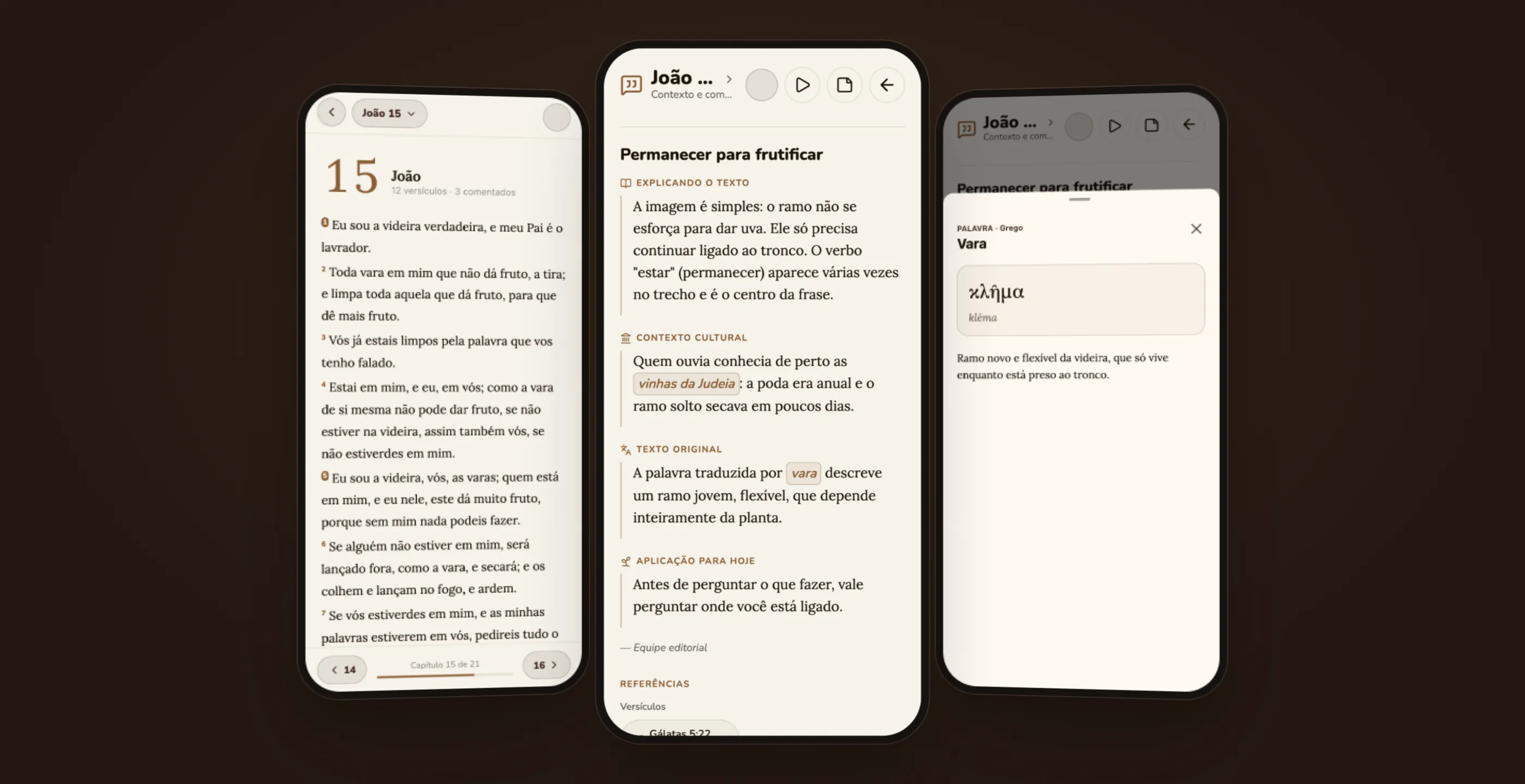
Simulators & AI assistantZeztra2026
The visitor gets the math on the spot, the assistant qualifies them through conversation, and the salesperson calls already knowing what the person needs.
- Client

- Role
- Product builder: strategy, design, and AI-driven development
- Timeline
- 8 months (Feb. to Sept. 2026)
- Disciplines
- Product strategy, UX/UI, Information architecture, AI-driven development
The context
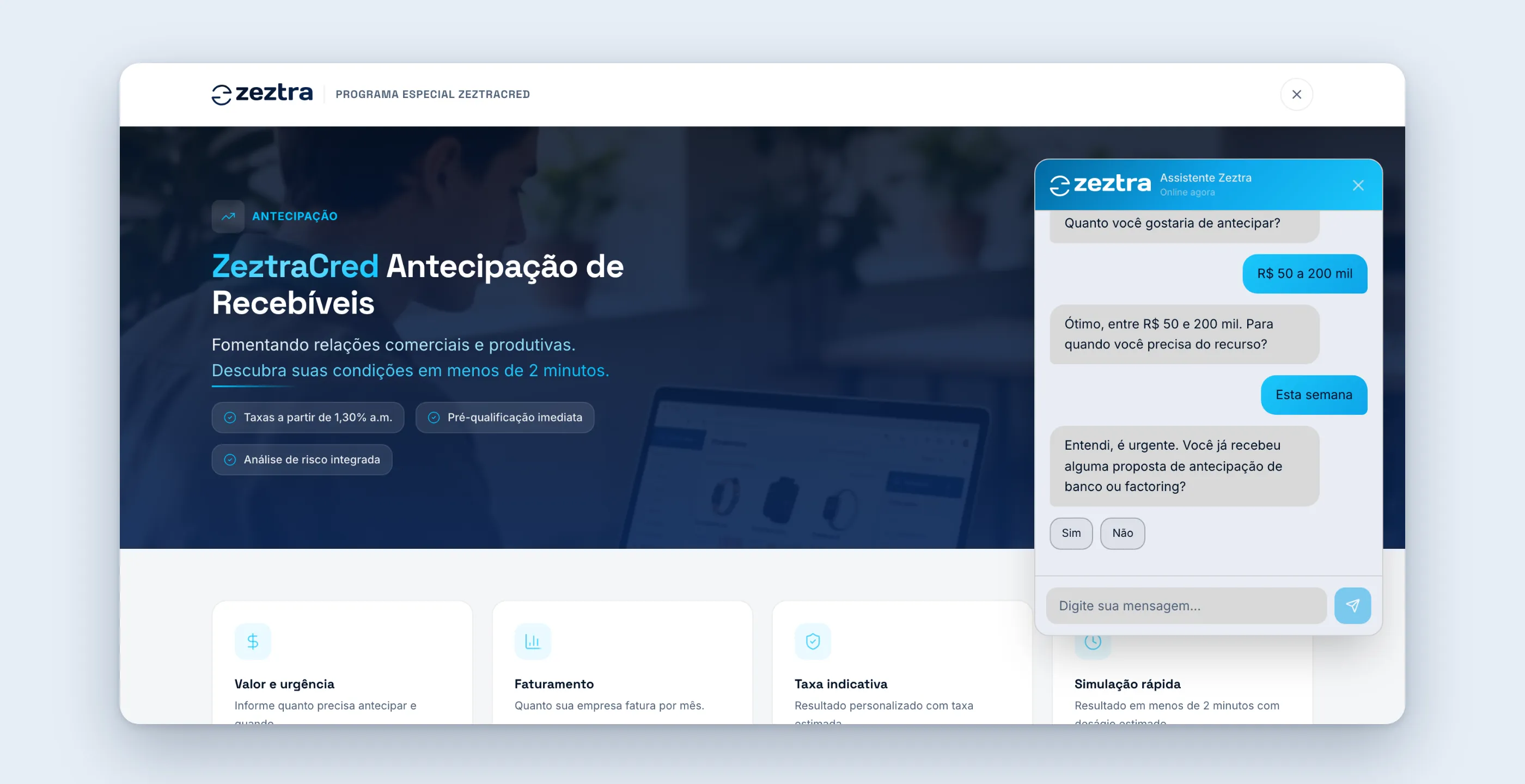
Zeztra is a B2B fintech that sells financial infrastructure to other companies: billing, payments, reconciliation, receivables advances, credit, and AI agents for the finance team. Zeztra’s customers are wholesalers, manufacturers, accounting firms, real estate agencies. People who don’t wake up wanting “financial orchestration,” but do wake up to overdue boletos (Brazilian bank slips), reconciliation in spreadsheets, and tight cash flow.
I was brought in to build the digital presence. It turned into something bigger: the entire layer that takes Zeztra from the ad to the conversation with sales.
What this layer automates is the first step of the sales conversation. The indicative rate, the maturity score, and the lead qualification now happen on the page, before anyone at Zeztra joins in. The salesperson comes in afterward, with everything the visitor already answered on screen. And what the AI assistant asks, in what order, and what it saves is defined by the product, not by the model.
It took eight months and a family of projects: a corporate website with simulators, a leads dashboard, a blog, an event page, an interactive sales deck, and a set of campaign surveys.
The pain
Selling B2B financial products comes with three points of friction.
- The vocabulary. The portfolio is technical. Buyers talk about pain, not architecture.
- Trust. Nobody hands over their revenue and receivables volume to a cold “contact us” form.
- Sales flying blind. When a lead comes in, it comes in without context. The salesperson calls and starts from zero: asks everything again, calculates later, answers later.
The product question was: how do we get visitors to leave with something useful before asking for any data, and get sales to receive those visitors already understood?
The research
The central decision was to treat every touchpoint as an exchange. The visitor gives information and gets back, right away, a result that matters to them: an indicative rate, a maturity score, a late-payment gauge. The lead is the consequence, not the price of admission.
That led to four principles, which became written rules in the repositories themselves:
- The buyer’s language. Internal product names are banned from campaign pages. No acronyms, no fintech jargon. Only the pain and the result.
- No made-up numbers. Any figure without a source is flagged in the code as pending confirmation with the Zeztra team, visible for review, instead of becoming final copy.
- No lead ever gets lost. On the website, forms, simulators, assessments, and conversations all land in the same database, with the source and campaign they came from. In campaign surveys, the rule is to save the lead before anything else: if the notification email fails, the lead is still saved.
- One component, many pages. A new survey starts from a template, not from a new layout.
The solution
Simulators that answer in numbers
There are three simulators: receivables advance, credit, and credit for online sellers. Each one asks only what changes the math: amount, urgency, revenue, whether there’s already a competing offer. The indicative rate comes from brackets that relate the amount requested to revenue. If the person has already received another offer, the simulator calculates its effective discount rate and says whether a better deal is within reach.
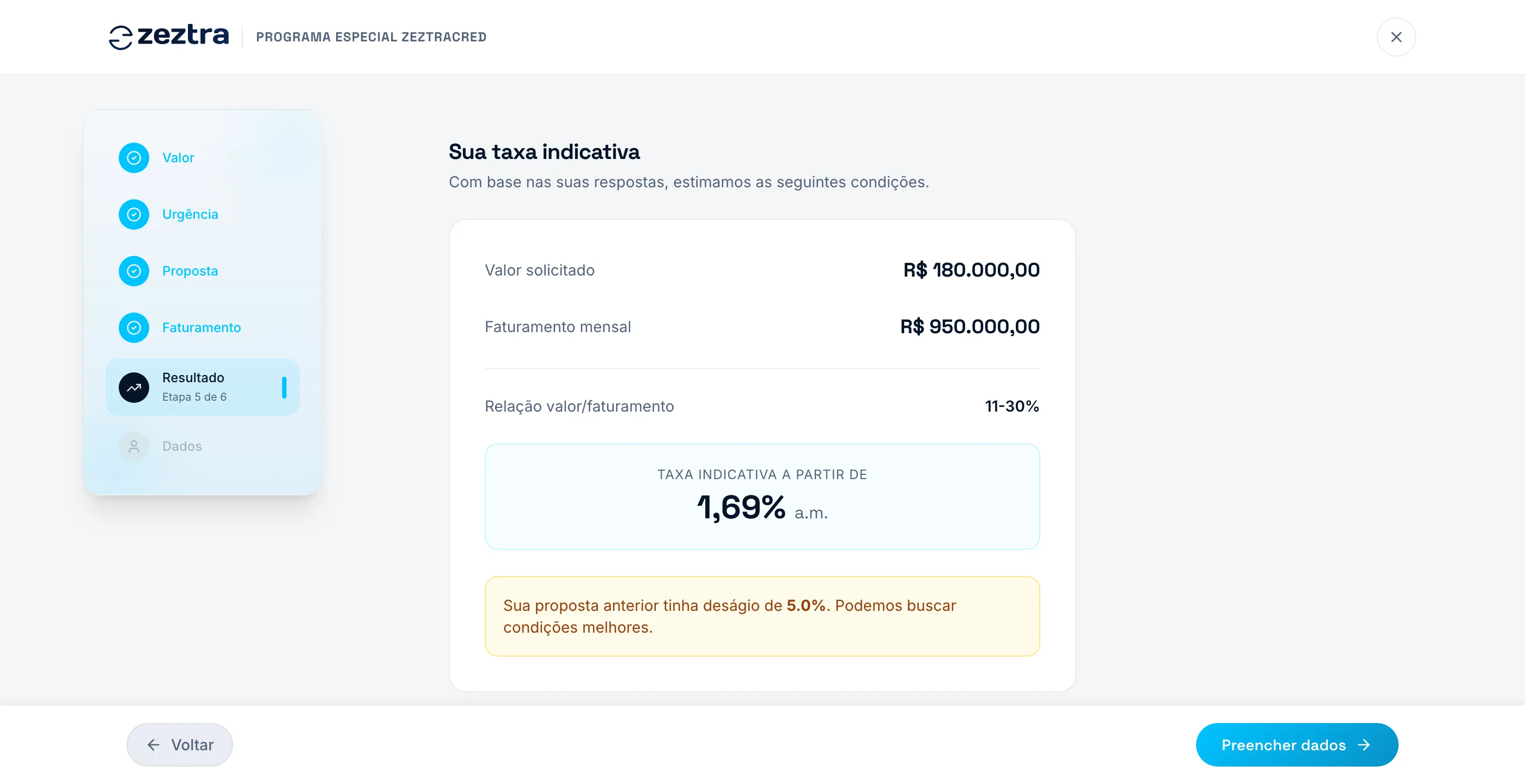
The legal disclaimer appears on every screen. It’s indicative, not an offer. The real proposal still comes from a person. In a financial product, that’s part of the design.
An assessment with an immediate result
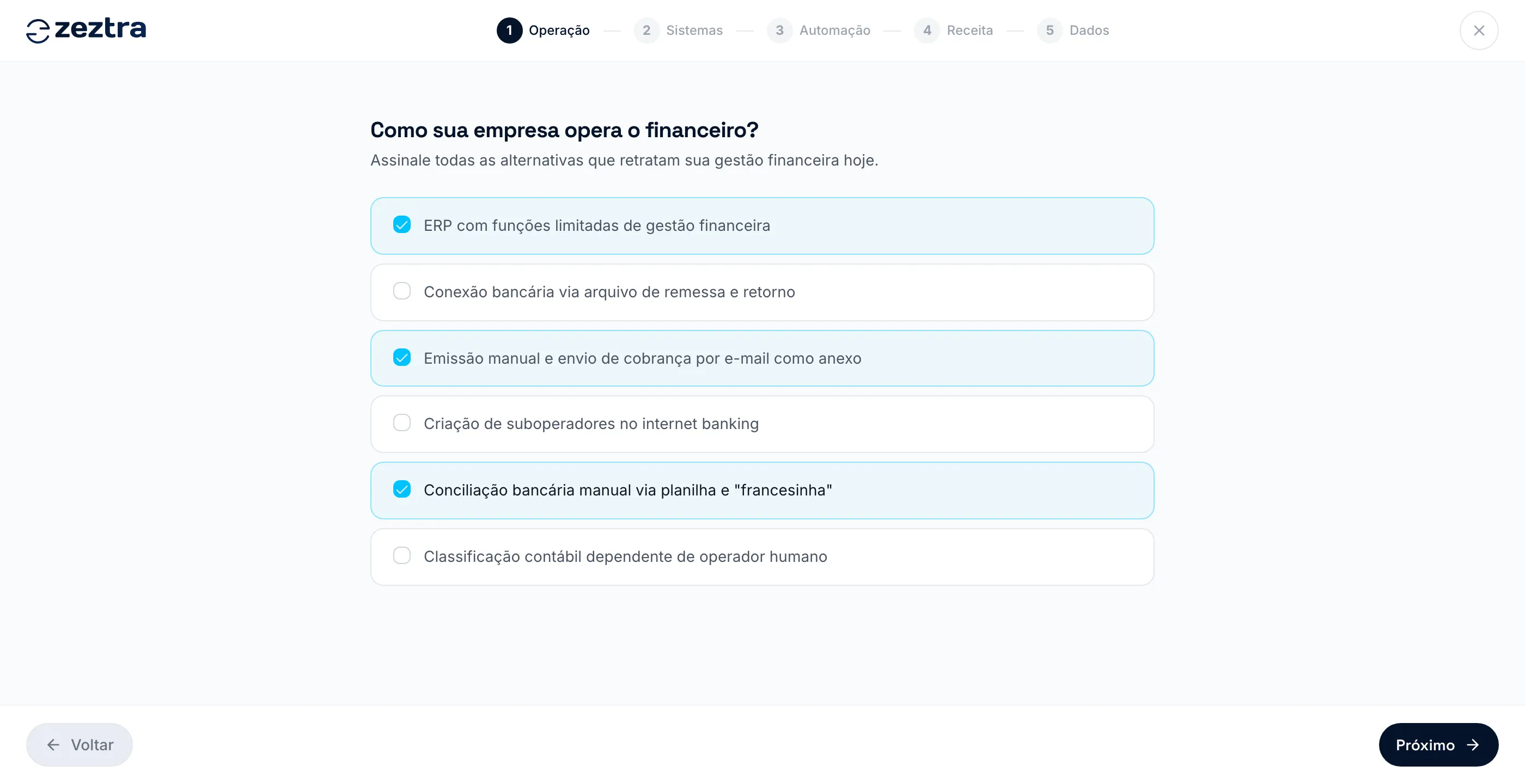
The free assessment has five named stages (operations, systems, automation, revenue, and data). The questions describe real situations in a finance team, like “manual reconciliation in spreadsheets,” so people recognize themselves and check the box.
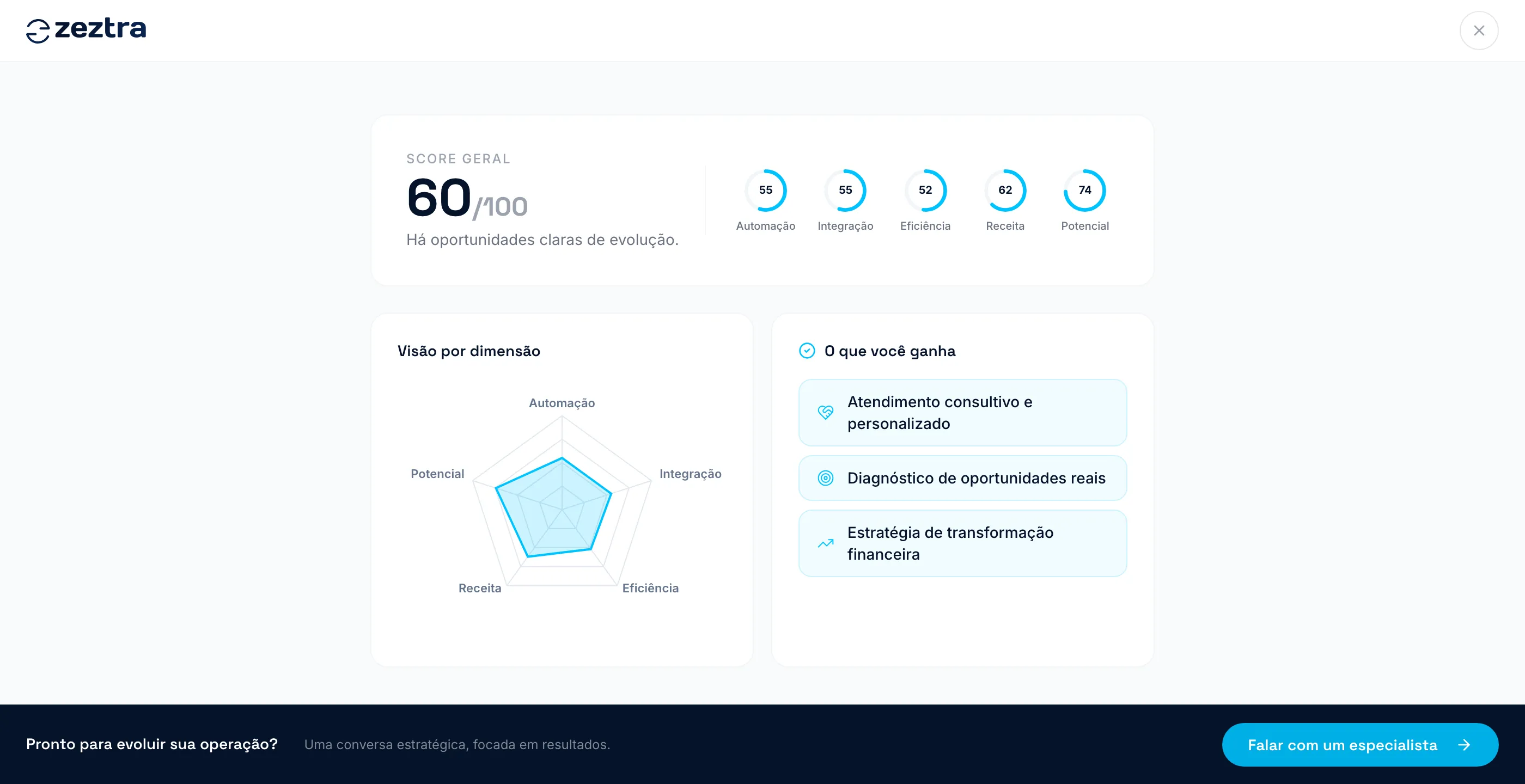
At the end come the overall score and five dimensions on a radar chart. It reads quickly, and the next step is pinned to the footer.
An assistant that qualifies through conversation
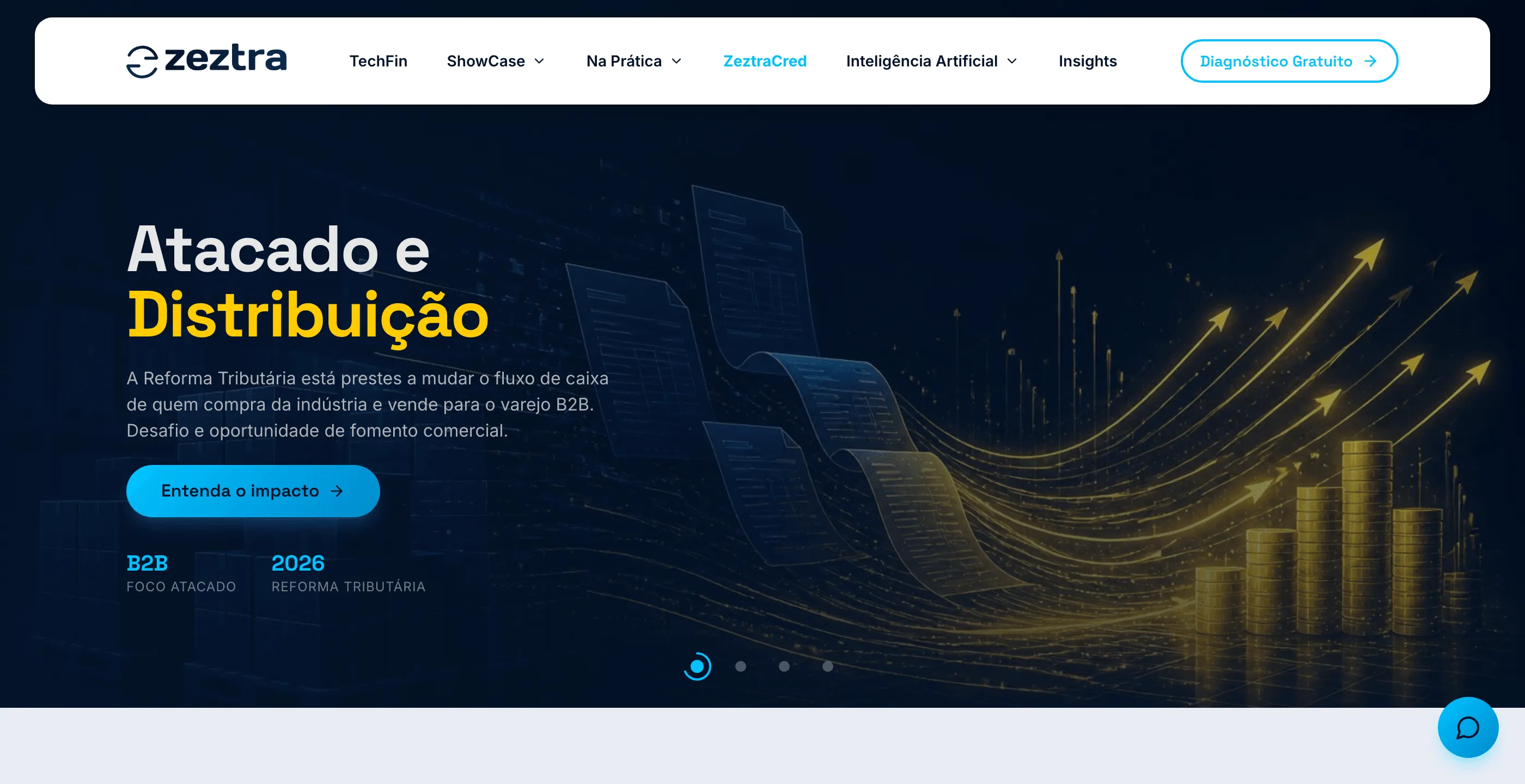
Not everyone likes forms. So each simulator and the assessment have a virtual assistant, Zê, who walks through the same path as a conversation. She asks one thing at a time, offers answers as buttons, and only asks for contact details at the end.
Behind the scenes, each page hands the AI a numbered script of steps, and it’s instructed not to skip any. With every reply, it also returns an invisible block with the data collected so far. That block fills in the same lead record the form would.
When the visitor provides their company and industry, a second call generates a summary of that business’s typical profile, and the conversation starts using that context. In the simulator for online stores, the assistant starts from the store’s URL to suggest opportunities.
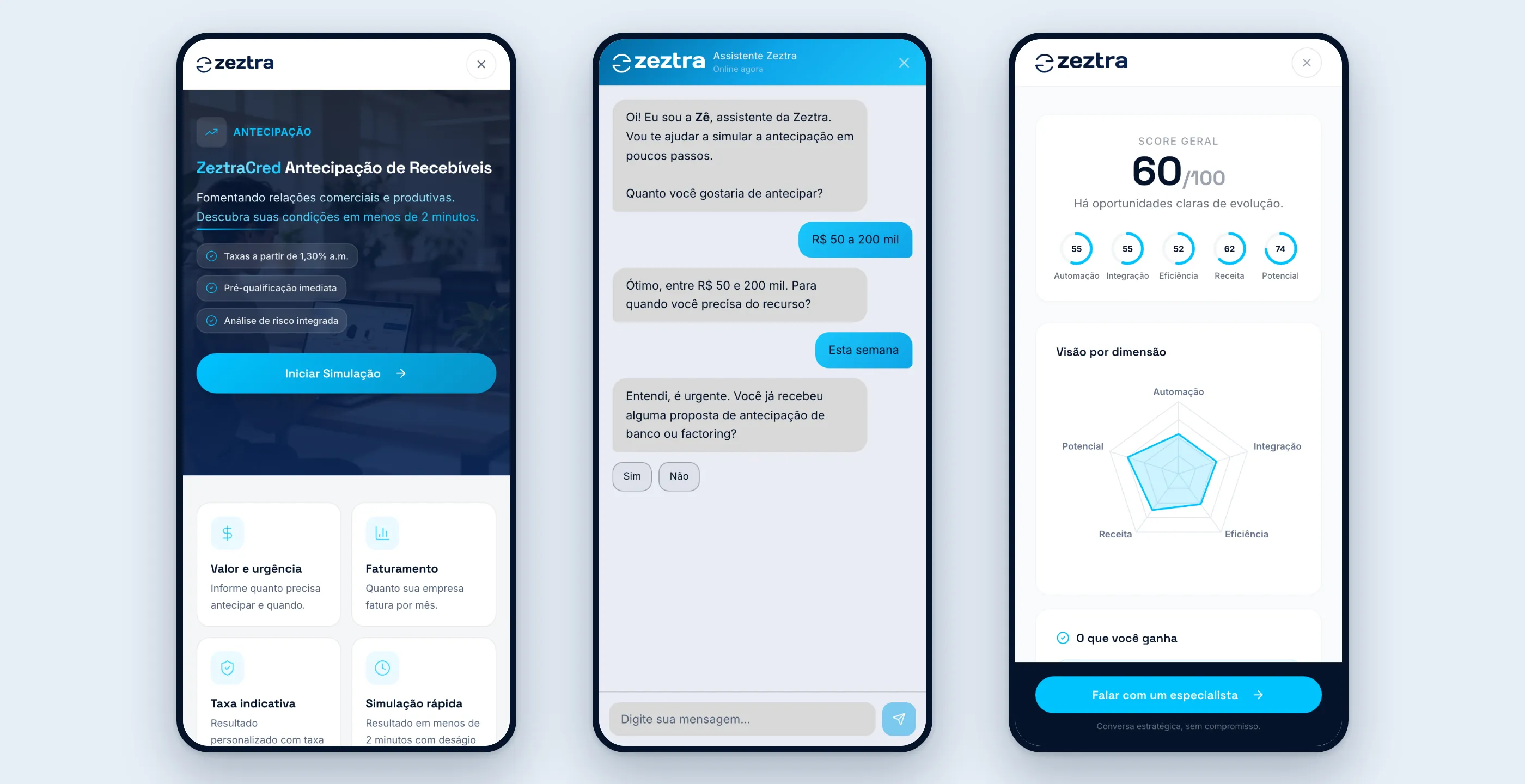
The decision that mattered most here was not letting the AI improvise the data collection. It converses naturally, but what it asks, in what order, and what it saves is defined by the product. The assistant’s base prompt is editable in the dashboard, with no deploy required. The people who adjust what Zê says are the Zeztra team.
The sales dashboard
Every lead arrives in a dashboard with source, page, campaign, and date. When they open a lead, salespeople see what the person answered: the simulation amounts, the calculated rate, the assessment score by dimension, the campaign source. They can comment, filter, and export. Each new lead also triggers an email alert.
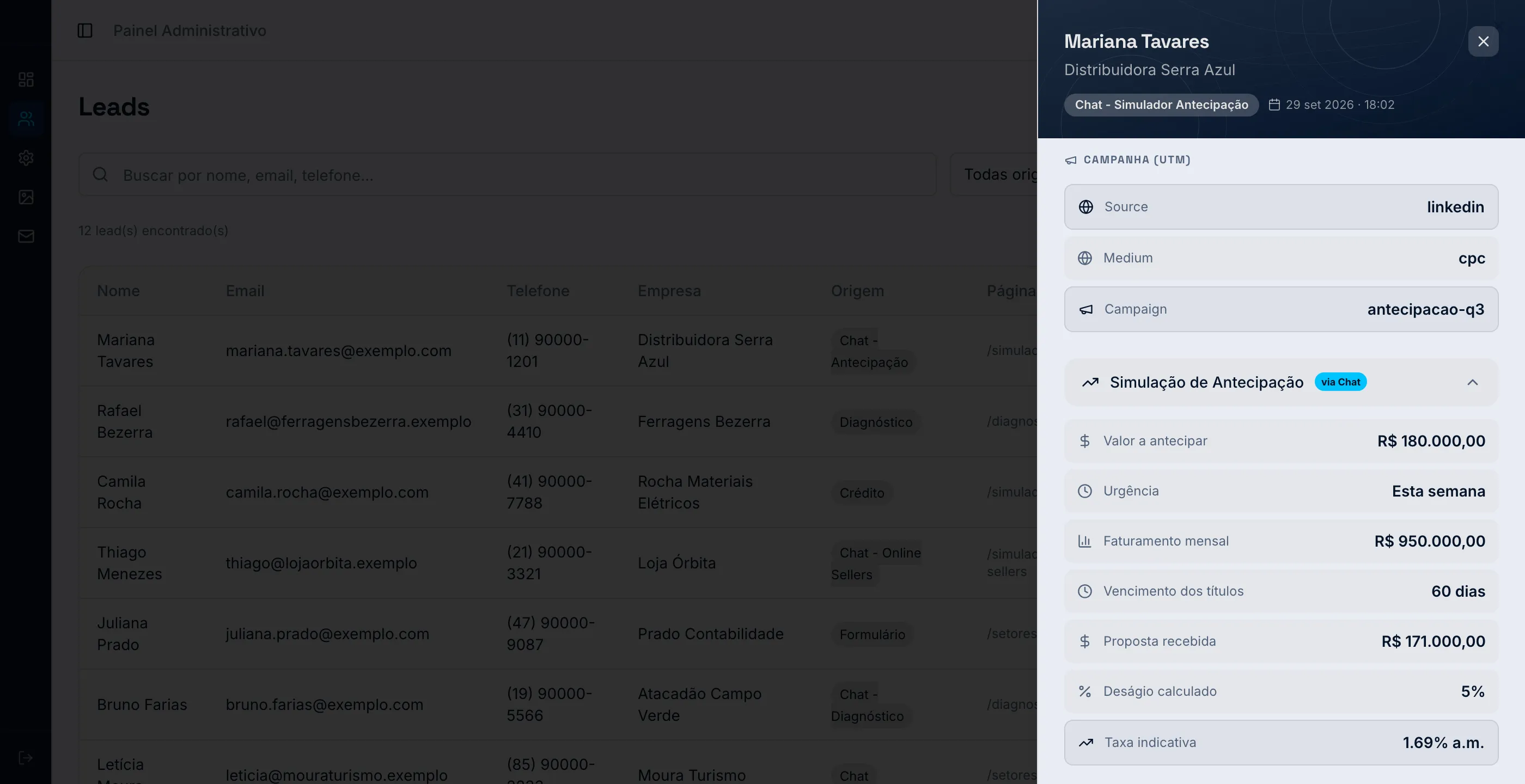
The same dashboard picked up small tools the team asked for: an email signature generator and social media mockups.
Campaign surveys at scale
With the site live, Zeztra’s campaigns started to need one page per topic, each with its own assessment. I built a scorecard-style survey engine. The page presents the pain, the survey asks five questions, and the lead is saved and classified as hot, warm, or cold, with nobody reading answers one by one. There are now eight surveys: late payments, collections, receivables advances, in-house credit, supplier management, customer self-service, financial maturity, and credit for wholesale.
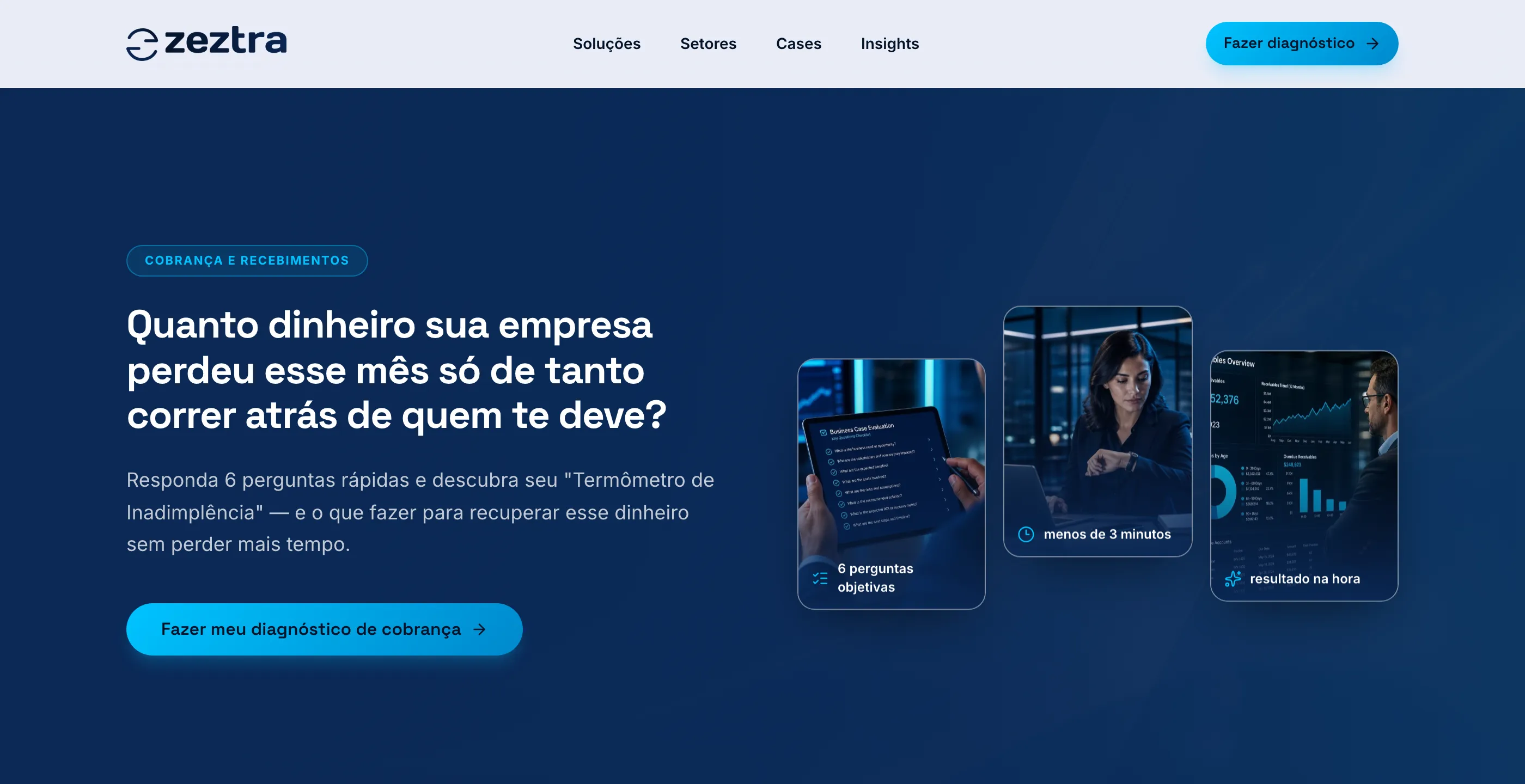
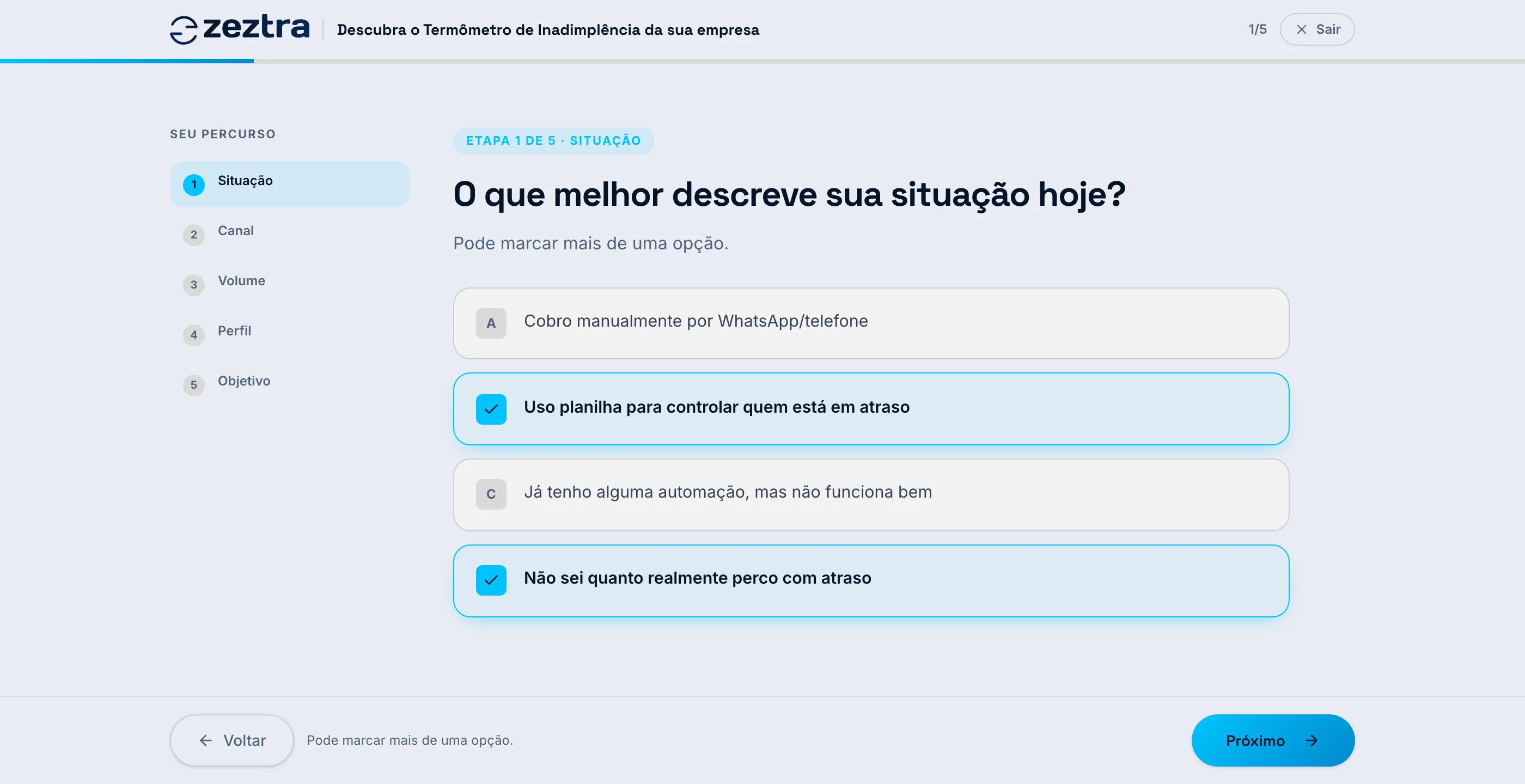
What made this sustainable was the process. Since the project is built by talking to an AI agent, I wrote a team of agents into the repository with defined roles: copy, design system, data, SEO, delivery, and QA. Each type of request triggers a group of those roles, with its own checklist. A new survey comes down to four content files. The layout is always the same, the tracking campaign is unique per survey, and all of them are recorded in a living catalog. The pages ship as static files to Zeztra’s server.
Blog, event, and pitch
Around all of that, three go-to-market pieces:
- A blog with its own editor, categories, scheduled posts, a newsletter, comments, and the same assistant answering questions. The old posts were migrated from WordPress.
- An in-person event page about embedded finance and Brazil’s tax reform, with an agenda, speakers, and later a recap page.
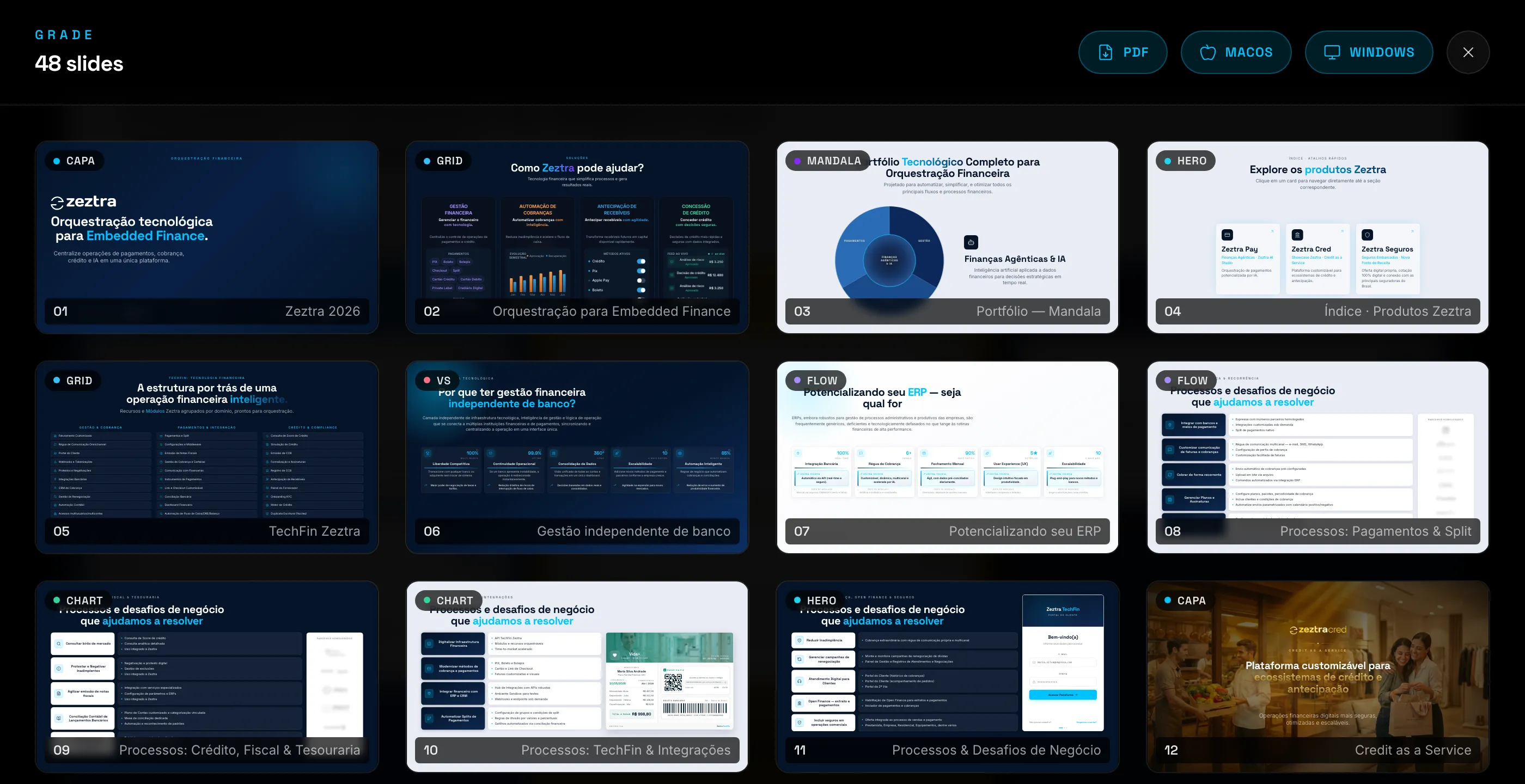
- A sales deck as an application: 48 slides in React, with keyboard navigation, a thumbnail grid, PDF export, and offline packages for Mac and Windows. It also has an “opening” mode that runs on its own in a loop. A version of it was used for the pitch at an AI-for-finance accelerator program.
Stack, in one line: React, Vite, and Tailwind for the interfaces, TanStack Start for the survey engine, Supabase for the database, authentication, and server functions, and AI through a gateway for the assistant and the profile summaries. All built with AI agents, under my review and direction.
What changed
The site and the eight surveys are live, and leads from every source land in the same database.
What was done by hand. The first contact through a cold form, with nothing in return, and the salesperson’s call starting from zero, asking everything again.
What became automatic. The indicative rate and the competitor offer’s effective discount rate, the maturity score across five dimensions, lead collection through the conversation, the company profile summary, the hot, warm, or cold classification, and the email alert for every new lead.
Where a person decides. The rate is indicative, never an offer: the proposal still belongs to sales. The assistant’s script belongs to the product, and its base prompt is edited by the Zeztra team in the dashboard. Every number without a source stays flagged as pending until someone at Zeztra confirms it.
What I took from this project
Delivering value before asking for data changes the conversation. A simulator that shows the effective discount rate of a competitor’s offer is worth more than any “talk to a specialist.”
Good AI in a funnel is AI on rails. The assistant only became reliable once the script, the order, and the fields belonged to the product, and the conversation belonged to the AI.
Scale comes from written rules, not effort. Eight surveys with the same look and the same quality only exist because the rules (language, sourced numbers, a single component, a single campaign) are written where the agent reads them.
Go-to-market is product. Website, deck, blog, and event were treated with the same discipline as any software: components, data, versions. That’s why everything talks to everything else.